A '''slam dunk''' is a type of basketball shot that is performed when a player jumps in the air and manually powers the ball downward through the basket with one or both hands over the rim. The term "slam dunk" was coined by Los Angeles Lakers announcer Chick Hearn. Prior to that, it was known as a '''dunk shot'''.
Now this video is about a group out of Hungary acrobatics which do amazing Slam Dunks using a trampoline
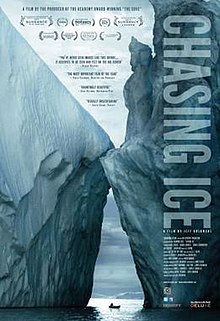
'''''Chasing Ice''''' is a 2012 documentary film about the efforts of photographer James Balog and his Extreme Ice Survey to publicize the effects of climate change, directed by Jeff Orlowski. It was released in the United States on November 16, 2012.
The documentary includes scenes from a glacier ice calving| event that took place at Jakobshavn Glacier in Greenland, lasting 75 minutes, the longest such event ever captured on film.
==Synopsis==
Acclaimed environmental photographer James Balog heads to the Arctic in order to capture images that will help to convey the effects of global warming. Balog was initially skeptical about climate change when the issue entered scientific discussion, but after his first trip north, he becomes convinced of the impact that humans have on the planet and becomes committed to bringing the story to the public.
Within months of the first trip to Iceland, Balog initiates The Extreme Ice Survey - an expedition to collect data on the seasonal changes of glaciers. Balog and his team deploy cameras that utilize time-lapse photography across various places in the Arctic to capture a multi-year record of the world’s glaciers.
The expedition starts off poorly as the team is plagued by numerous technical problems and camera malfunctions. Meanwhile, due to the extreme physical nature of the expeditions, Balog's personal health suffers in the form of knee complications.
After making improvements to the equipment, Balog and his team are finally able to collect time-lapse photos that depict the drastic erosion and disappearance of enormous, ancient glaciers. In the next video, James Balog gives a creat spech about what is happening:
This is a famous video is from the "Billabong Odyssey" documentary ( i recommend everybody to see). It's about getting together the best giant wave surfers of the world (Including number one , Laird Hamilton), on a quest to travel around the globe to search for the biggest ride able wave.
The Jaws surf break is roughly three miles east of Paia, Hawaii/Pā
When the Maui surfers John Roberson, John Lemus, and John Potterick were surfing the break in 1975, they noticed a sudden change in the conditions to huge dangerous waves, and gave it a nickname after the film ''Jaws'', comparing the unpredictability to a shark attack.
In the 1980s, a few intrepid windsurfing|wind surfers reached the break from Ho'okipa|Ho.
The wave sizes at Jaws (which can exceed convert|60|ft during the months of December to March) attract big wave surfers such as Laird Hamilton and Dave Kalama using the tow-in surfing method of big wave surf riding they co-invented (with Darrick Doerner and Buzzy Kerbox)
Since the steep cliffs and fast-moving waves prevent paddling to the break, surfers are towed by personal water craft launched from nearby areas such as the boat ramp at Māliko Bay.
The extreme size of the waves is caused by the structure of an underwater ridge which has been studied by scientists.
The publicity greatly increased the popularity of the site, resulting in over-crowding by 2004.
The lookouts on the cliffs above the break are the best vantage points for spectators; professional photographers use boats or helicopters.
There have been several "World Cup of Tow-in Surfing" contests held, but the changing conditions mean the dates cannot be set in advance
The Billabong XXL awards given to big wave surfers often have several nominated from the Jaws break in the "biggest wave" category.
Even experienced surfers can be seriously injured on the violent waves, and the remote location requires expensive rescues via helicopter.
'''Wingsuit flying''' or '''wingsuiting''' is the sport of flying the human body through the air using a special jumpsuit, called a '''wingsuit''', which adds surface area to the human body to enable a significant increase in lift (force)|. Modern wingsuits, first developed in the late 1990s, create the surface area with fabric between the legs and under the arms. Wingsuits are sometimes referred to as a '''birdman suit''' (after the makers of the first commercially available wingsuit), '''flying squirrel suit''' (due to their resemblance to the Flying squirrel-animal. Squirrel is now the name of a commercial wingsuit manufacturer), or '''bat suit''' (due to their vague resemblance to the Bat/animal or perhaps the Batman/superhero).
A wingsuit flight normally ends with a parachute opening. So a wingsuit can safely be flown from any point that provides sufficient altitude for flight and parachute deployment (normally a skydiving drop aircraft or BASE jumping| BASE jump exit point).
Technical mechanics
The wingsuit flier enters freefall wearing both a wingsuit and parachute equipment. Exiting an aircraft in a wingsuit requires skilled techniques that differ depending on the location and size of the aircraft door. These techniques include the orientation relative to the aircraft and the airflow while exiting, and the way in which the flier will spread his legs and arms at the proper time so as not to hit the aircraft or become unstable in the relative wind. The wingsuit will immediately start to fly upon exiting the aircraft in the relative wind generated by the forward speed of the aircraft. Exiting from a BASE jumping site, such as a cliff, or exiting from a helicopter, a paraglider, or a hot air balloon, is fundamentally different from exiting a moving aircraft, as the initial airspeed upon exit is absent. In these situations, a vertical drop using the forces of gravity to accelerate is required to generate the airspeed that the wingsuit can then convert to lift (force)|.
At a planned altitude above the ground in which a skydiver or BASE jumper would typically deploy his parachute, a wingsuit flier will deploy his parachute. The parachute will be flown to a controlled landing at the desired landing spot using typical skydiving or BASE jumping techniques.
A wingsuit modifies the body area exposed to wind to increase the desired amount of [[lift (force)| with respect to drag (physics)| generated by the body. An attainable glide ratio of some wingsuits is 2.5 or more. This means that for every meter dropped, two and a half meters are gained moving forward. This ratio can be referred to as flight efficiency. With body shape manipulation and by choosing the design characteristics of the wingsuit, a flier can alter both his forward speed and fall rate. The pilot manipulates these flight characteristics by changing the shape of his torso, de-arching and/or rolling of the shoulders and moving hips and knees, and by changing the angle of attack in which the wingsuit flies in the relative wind, and by the amount of tension applied to the fabric wings of the suit. The absence of a vertical stabilizing surface results in little damping around the [yaw axis], so poor flying technique can result in a spin that requires active effort on the part of the skydiver to stop.
Wingsuit fliers can measure their performance relative to their goals with the use of freefall computers that record the amount of time they were in flight, the altitude they deployed their parachute, and the altitude they entered freefall. The fall rate speed can be calculated from this data and compared to previous flights. [GPS] receivers can also be used to plot and record the flight path of the suit, and when analyzed can indicate the amount of distance flown during the flight. BASE jumpers can use landmarks on exit points, along with recorded video of their flight by ground crews, to determine their performance relative to previous flights and the flights of other BASE jumpers at the same site.
A typical skydiver's terminal velocity in belly to earth orientation ranges from 110 to 140mph (180–225km/h). A wingsuit can reduce these speeds dramatically. A vertical instantaneous velocity of −25mph (−40km/h) has been recorded. However the speed at which the body advances forward through the air is still much higher.
The tri-wing wingsuit has three individual [ram-air] wings attached under the arms and between the legs. The mono-wing wingsuit design incorporates the whole suit into one large wing.
I've found three jumps which have different heights and should be judged differently. The differences is how they where performed, and the story behind them.
The first jump, is a 100foot cliff. The skier makes a front flip and nails the landing!
The second, is a 255foot drop,,,, 105feet more than the first,,,,on this height stomping the landing is impossible (my opinion). But the courage of this guy is just incredible!
The 3rd jump is world record in height alright (355ft-107m!!!),,,, But was actually jumped by accident. When a skier (Fred Syversen) jumped the cliff on the wrong spot and plunged 107m and survived the fall.
The '''Red Bull Rampage''' is an invite-only freeride downhill mountain bike competition held near Zion National Park in Virgin, Utah, USA, just to the north of Gooseberry Mesa. Previously it was held off the Kolob Terrace Road, on the western boundary of Zion National Park. The competition was held from 2001–2004 and then canceled due to the increasing risk competitors were taking. The Rampage however was re-introduced for the 2008 season. In 2010, the event was held October 1–3.Since then Red Bull rampage has become one of the biggest mountain biking events of the year.
The event is similar to freestyle skiing and freestyle snowboarding|snowboarding, where competitors are judged on their choice of lines down the course, their technical ability and the complexity of tricks. For the 2008 event wooden features have been introduced to what has previously been a 'Natural' only course.
Danny MacAskill, (born 23 December 1985) is a Scottish Mountain bike trials| cyclist, from Dunvegan on the Isle of Skye. He works professionally as a Mountain bike pro rider for Inspired Bicycles Ltd.
He released "April 2009", a five-and-a-half-minute street trials video, filmed by his flatmate Dave Sowerby, on YouTube on the 19 April 2009 to popular acclaim and widespread media attention
As of April 2009, MacAskill had been practising for more than 12 years. He gave up his job as a mechanic so he could ride full-time.
On 16 November 2010 MacAskill released a new video "Way Back Home" produced by Red Bull Media House. The video showcases locations around Scotland including Edinburgh Castle, North Berwick, wartime bunkers on the island of Inchgarvie beneath the Forth Bridge and the Cruachan Dam in the Scottish Highlands.
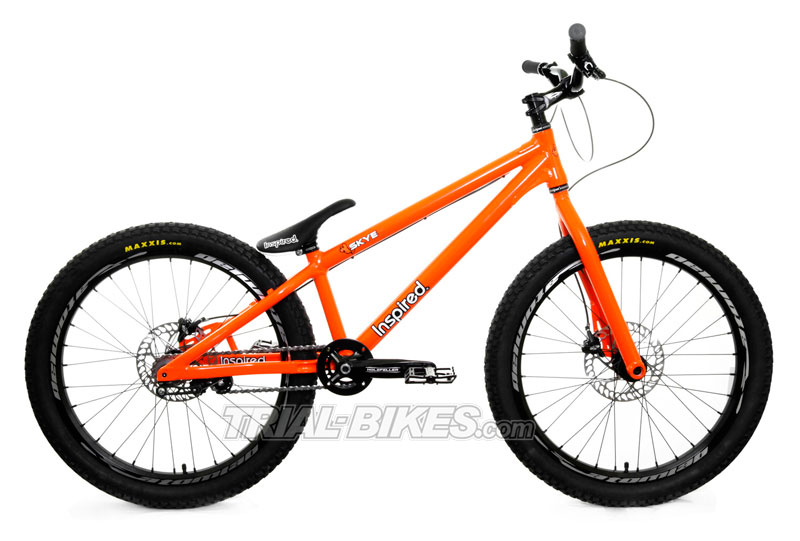
In 2011 MacAskill, along with Inspired Bicycles, released his signature trials frame, the "Inspired Skye".
In 2012, Danny MacAskill performed the stunts for the movie Premium Rush.
In summer 2013, MacAskill published a trial biking project on YouTube called ''Imaginate'' which had been shot over 18 months with sponsorship from Redbull. In less than three weeks, the video had received over 4 million views, and has now already passed the 10 million.
(sorry, for some reason i could only link this video) IMAGINATE VIDEO LINK
Astonishing images shot from a helicopter view from a storm that hit the coast of North Eastern point of France on the 9th of December of 2007. This has nothing to do with extreme sports, but there must of run a lot of adrenaline through the body of the people stuck on these lighthouses!
This is a guy is not riding a bike anymore , because the bike seems to be just another part of his body Pure control, no words, the images speak for themselves.
This is one of those videos i stumbbled over on you tube and since then it stayed in the back of my mind, it impressed me so much, i decided it deserves a place in the blog, even if i could not get any information. The bravery of these people goes beyon comprehension, one thing is for sure,,,they are not crazy,, they just live on the edge but always believing they are going to make it. If it wasn't so, you could say they are.